Pictures of Spennymoor
About Spennymoor
Long before Spennymoor ever existed there was... Spenny Moor. Spenny Moor was a vast area of common land, and we are indebted to noted historian and antiquarian Robert Surtees (1779 - 1834) whose death is commemorated at nearby Bishop Middleham, for his description of the extent of the moorland. He wrote that it extended from Auckland Park on the road to Bishop Auckland to just short of Sunderland Bridge, and in the opposite direction from the site of Whitworth Hall to the foot of Fery Hill and Kirk Merrington. The area was common land, owned by the Prince-Bishops of Durham, and according to Surtees was covered in thickets of briar, thorn and gorse as well as thistles, and was skirted by dense forestation, according to local legend the home of fierce wild boar. Although the town did not exist until the 19th Century, there were many settlements around the perimeter of the moor which date back much further, namely the Merringtons (East, West and Middle) now known as Kirk Merrington, Westerton and Middlestone, Byers Green and Old Park, Whitworth, Tudhoe, Croxdale and Hett, some of which later became part of the expanding township.
There are a number of opinions on how Spennymoor got the name, but the simplest and most likely relies upon etymology – the study of words and their roots. The word for 'thorn' in both the Celtic tongue of the Ancient Britons and in the Latin spoken by their Roman conquerors was 'spino' and the Saxon word for common land was 'mor', leading to the name Spino Mor, which changed sometime between the middle of the 13th to 15th Centuries, by which time it was already being referred to in documents of the Bishopric as 'Spenyngmore'.
The founding of the township, which took its name from the moor on which it was built, came about because the area lay on a rich seam of coal, and for hundreds of years 'coalle pitts' had been dug on the moor. When the mineshaft at Whitworth Park was sunk in 1839 by the Durham County Coal Company, it was a full 2 years before the first coal arrived at the surface. This led to an influx of men hoping to find work in the mine, and the houses built to accommodate them led to the beginnings of the town, which traditionally dates from July 1841. It may be more than simple coincidence that the Annual Town Gala is held each year on the second Saturday in July – the anniversary of the town's birthday!. The colliery was one of the last in the Spennymoor area to close on 29th September 1974.
A Victorian boom-town of the late 19th Century, the growth of Spennymoor was based on coal mining and steel production. At its peak the Tudhoe Ironworks was the largest plate mill in Europe, and it was towns like Spennymoor that made possible the gigantic advances of the Industrial Revolution. Sadly the closure of the Ironworks in 1900, caused a decline in fortunes for the town, which again suffered badly when coal mines were closed in the 1960's. Many local men and boys lost their lives in the mines and this is commemorated in the Victoria Jubilee Park, by a memorial known as 'The Tubs' featuring a bright planting of flowers in tubs which were originally used underground in Ellington Colliery, Northumberland, and in a memorial in Tudhoe cemetery to the Tudhoe Colliery Disaster which occurred at about 1.15 am. on the morning of 18th April 1882, when an explosion, said to be caused by a fall of stone in the Engine Plane of the Brockwell Seam, resulted in the loss of life of 37 men and boys, some as young as 15.
The Spennymoor of today is again suffering due to unemployment figures well above the national average, through the loss of engineering jobs which are being moved to other countries where labour costs are cheaper. Hope for the future is high, however, with a new factory being built for International Lighting Technologies (formerly Thorn Lighting) and the manufacture of undercarriages for tracked vehicles newly transferred from Teesside by Berco, a subsidiary of the European engineering giant Thyssen-Krupps. Another new development on the jobs front is the Durham Gate an Industrial Estate which, when completed in the next few years will comprise an Office Village and small factories supported by a futuristic services hub on land currently occupied by Black & Decker.
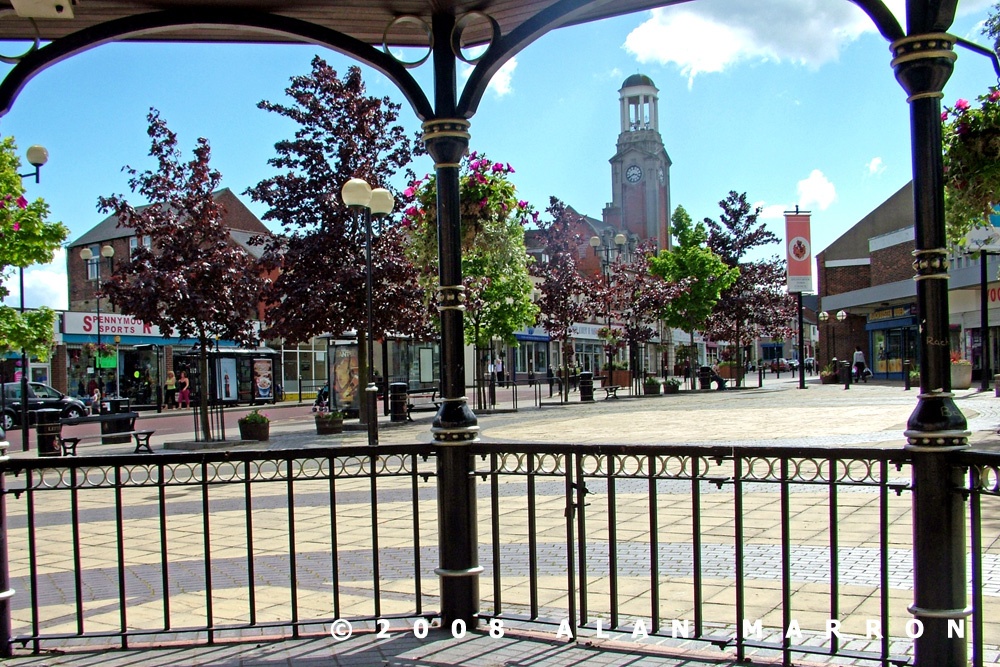
The clock tower of the town hall was built around 1916, and came to be regarded as a local icon, still visible to everyone who approaches the town centre.
Spennymoor Leisure Centre is home to the Regional Gymnasium Centre, designed to train Olympic Gymnasts of the future, as well as hosting facilities for a great many other sports, and the beautiful Jubilee Park, the envy of much larger towns, is in process of being further improved to provide better play facilities for local children. For many years it has boasted two bowling greens which provide home for some of the most successful teams in the county.
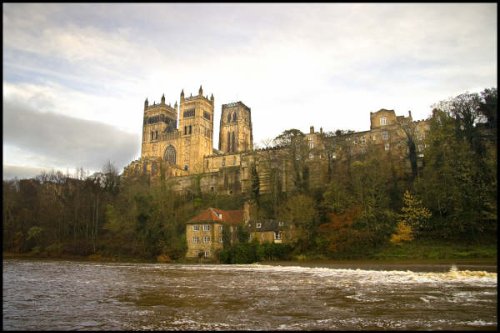
The Roman Fort at Vinovium, one of the most important and best preserved in the North of England, lies just a few miles away in one direction, and the Cathedral City of Durham in the other, making the town an ideal centre for visitors to 'The Land of the Prince Bishops'.
The main shopping centre, 'Festival Walk' was a typical shopping precinct when it was built by Arndale Developments of Leeds in the mid 1960's, but like many of its kind is now unfashionable and incapable of expansion. New owners are understood to be planning the demolition of half of the precinct, probably in 2010, and it is expected that it will be replaced by a shopping mall, in keeping with more modern developments. Netto and Lidl are preparing to move into new premises in the town, and both hope to be open later in the year.
Information provided by
Alan Marron
For more pictures and local information, please visit:
www.spennynews.com