
Please login or click here to join.
Forgot Password? Click Here to reset pasword
 |  |  |  |  |  |
Rose Goth Posts: 16 Joined: 20th Jan 2008 Location: Canada | quotePosted at 23:55 on 31st March 2008
Hey, I can't keep up hear!!! so, I thought technology was supposed to make your life easier. Lynda, ...I got this computer in december '07, got internet in January, had my firts complete crash and wipe a few days later, and have been fighting bugs of all kinds ever since. Have currrently something called"About:Blank" that disguises itself as a blank home page/ search page, and progressively takes over all aspects of your computer pertaining to web usage. I've downloaded and tried practically evry free scanner and bug remover on the web. Much to my horror I discovered that many of them are harder to remove than the bugs and now I have to put up with them bumping and grinding as they battle over who gets to start-up first in the morning and be forst in line on the toolbar! |
| Rose Goth Posts: 16 Joined: 20th Jan 2008 Location: Canada | quotePosted at 23:59 on 31st March 2008
Lynda, to make a long story short, when i actually get the dang computer working properly I might have time to figure out how to use my brand new digital camera. I have some interesting photos that are not me, might be better than a chess peice if a kind soul cares to explain to this computer newbie how I go about making something from "MY PICTURES" folder behave like a POE avatar! Rose |
L Posts: 5656 Joined: 10th Jun 2004 Location: UK | quotePosted at 07:41 on 1st April 2008 I'm a kind soul Rose (I think) I'm sure sure will sort out your pc and how your camera works......eventually lol As for putting your photo on the Avatar, if you can manage to do it, just make it smaller before you upload it (unless you took a small photo in the first place) |
Peter Evans Posts: 3863 Joined: 20th Aug 2006 Location: UK | quotePosted at 12:58 on 1st April 2008 Hi Rose, sorry I cant help much with which came first, wattle and daub or cob. But, wattle and daub was very prevalent during the Tudor period. The houses were oak frame structures, and the wattle was then used to fill the spaces between the frames. Then the daub was added to stop wind whisteling through. The daub was then "painted" with a limewash to help waterproofing. Only the very rich had ornate woodwork, just to prove how rich they were. I think the poorer people used the cob build,because of the strength and cheapness of it. Lets face it, it was free. Just dig up some mud, get some old straw from the fields, and add water. Mix well, and dry out. Because most houses were built in the wood frame style for hundreds of years, and the fires were on a hearth in the middle of the living area, the whole house was warmed. But after the great fire of London, a law was passed saying that, all houses were rquired to have a stone chimney and hearth. This was to cut down the risk of a repeat of the fire. Later, when baked mud bricks had been (invented), the wattle and daub was replaced by bricks. A lot of old Tudor houses now have these brick fills in intricate patterns. So maybe it was a local thing, cob more in the country, and wood frame and wattle and daub in the towns and the lords manor. May not be entirely correct, but not far off. Hope this helps. Peter. |
Ron Brind Posts: 19041 Joined: 26th Oct 2003 Location: England | quotePosted at 14:32 on 1st April 2008 I told you he was old! |
Sue H Posts: 8172 Joined: 29th Jun 2007 Location: USA | quotePosted at 14:59 on 1st April 2008 On 1st April 2008 12:58, Peter Evans wrote:
But they all died of smoke inhalation. Even with a small hole in the roof, the smoke had no where to go, it must have been awful. |
| Peter Evans Posts: 3863 Joined: 20th Aug 2006 Location: UK | quotePosted at 15:51 on 1st April 2008 But it was warm though. Especially when the thatch caught fire. lol |
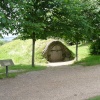
| Peter Evans Posts: 3863 Joined: 20th Aug 2006 Location: UK | quotePosted at 15:57 on 1st April 2008  Picture by Peter Evans |
| Sue H Posts: 8172 Joined: 29th Jun 2007 Location: USA | quotePosted at 16:13 on 1st April 2008 I love your pictures of Avebury, Peter. I've been there a few times, but have only paid attention to the stones. I would like to go back again now, and pay more attention to the homes and the church. So much beauty, so little time. |
| Peter Evans Posts: 3863 Joined: 20th Aug 2006 Location: UK | quotePosted at 17:33 on 1st April 2008 To get to those houses, you have to leave the village and walk the country lanes Sue. We were walking the Ridgeway Path. So if you follow that, you will get to see them. Its only 75 miles long. He he he. |
Follow PicturesOfEngland.com on social media and help share the beauty of England....


