Pictures of England England photo sharing
 Exploring the most Picturesque & Historic parts of England..

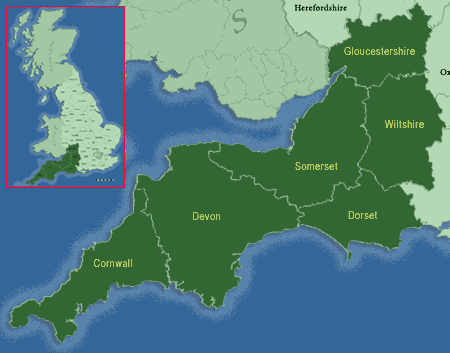
The West Country Map & Guide

A Guide to the South West of England

Explore Cornwall Explore Devon Explore Somerset Explore Gloucestershire Explore Dorset Explore Wiltshire The West Country of England is outstanding in natural beauty, it is almost entirely bounded by the sea, with its southern shore-line being blest with a mild climate and glorious sandy beaches nestling beneath colourful cliffs.

Both the Exmoor National Park and the hauntingly beautiful Dartmoor National Park lie in the West Country. Exmoor, belongs mostly to the county of Somerset and being a varied world shows three entirely different landscapes; coastal, rolling pastoral moorland including fertile farmland, and heathland. The pastoral moor is rich grazing country, the heathland is the home of red deer, grouse, ponies and sheep, it has echoes of R.D.Blackemore's novel Lorna Doone. Exmoor has numerous Somerset villages reached via leafy lanes, with many strung out along Exmoor's coastal shoreline.

If Somerset has abidingly beautiful countryside, hidden hamlets and villages, it also has fine towns and cities. Of these, Taunton, in the Vale of Taunton Deane, on the River Tone, is a lively commercial centre, rich in atmosphere with a restored historic castle. Bristol is notable for the fine suspension bridge spanning the magnificent Avon Gorge high above the River Severn, and for its transformed docklands where in the 17th-century clippers sailed for distant lands laden with wool, often returning with a cargo of glittering goods and galley's full of slaves. Thornbury is a town renowned for its Tudor castle, one of the most imposing Tudor buildings of the West, whilst Minehead is Somerset's most southerly town.and one of its most popular seaside resorts. Another is Weston-Super-Mare, once a quiet fishing village, this is now famous for its miles of golden sands, pretty gardens and bright lights. Beneath the cavernous Mendip Hills lies the small town of Cheddar, this is found at the end of a rugged limestone gorge and is best known for its Cheeses, Cider and as the entrance to the eyrie, but colourful Cheddar Caves.

At the heart of Somerset is the finest core of medieval buildings in the West Country, these are found in the tiny Cathedral City of Wells where the Cathedral, moated Bishop's Palace, Vicars Close and Deanery, remain as historic buildings, quite without parallel.

The beautiful city of Bath, also in Somerset, is as much in vogue today as it was when the Romans built it thousands of years ago. It is beloved for its many splendid Georgian Crescents crammed with handsome stone houses of the era, for its Roman Baths reconstructed in the age of the Victorians and for the wonderful Pump Rooms. The pump rooms provide an elegant place where you can relax and sample the famous spring water.

From high above Bath, on its northern ridges you can take advantage of fine views across Gloucestershire towards Stroud and the Slad Valley, the true "Cider with Rosie" country epitomised in the novel by Laurie Lee.

The rolling landscape of Wiltshire abuts with Somerset. Wiltshire has the face of ancient Britain, the enigmatic Stonehenge, thought to have probably been a place of Pagan worship since 2000BC. Standing next to these huge boulders it is hard to imagine how early man, with only the use of primitive tools, managed to leave such fantastic carved stones behind.

Rolling farmland, sown with wheat and barley defines Wiltshire, together with Salisbury, a dignified city whose cathedral spire rising above misty water-meadows, this is one of the most memorable sights of this glorious ancient county.

Devon's spectacular northern coast alternates between grey rocky promontories running down to the sea, sheer tall colourful cliffs and long stretches of golden sands. This has the holiday resorts of Ilfracombe, Woolacombe, charming Westward Ho immortalised by Charles Kingsley's famous novel and Clovelly, one of the show places not only of Devon but of Britain. Devon's southern coast extends from Dawlish to Brixham, it is mostly noted for Torquay whose palm trees, luxury hotels and colourful harbour give the town the look and feel of the Mediterranean. Fishermen have sailed from Brixham almost since time began, and artists are drawn here by the lure of colour-washed cottages tumbling around and above the quayside.

Dartmoor is Devon's open wilderness, it is famed for its prison and for its wild, desolate beauty. This is the largest tract of open land left in southern England and as a National Park it is somewhat larger than Exmoor by 100 square miles. The area shows well the complex beauty of the landscape, it possesses high hills, moors, valley's, dense woodland, hidden hamlets, peaceful villages and lively market towns. The drama of the landscape lies in the huge summits, two reach to heights of over 2,000 feet, these being Yes Tor and High Willhays. Pleasant sights and sounds of Dartmoor include its wild ponies (although today most are very tame), and the Drover's Bridge at Postbridge, used in the Middle-Ages for trains of pack-horses transporting metal from local mines. A great photographic opportunity is the cluster of thickly thatched cottages at Buckland-in-the-Moor, and the 12th-century church crowning misty Brent Tor.

Exeter is Devon's Cathedral and University City, this lies on the River Exe as it makes its way towards nautical Topsham and the sea. Close to Devon's borders with Dorset, is delightful Honiton, a town long famous for its lace; Queen Victoria's wedding veil was made of Honiton lace, the town's attractive buildings are mainly late Georgian.

To the east of Devon lies the county of Dorset which is often referred to as "Hardy's Wessex" for no other person loved the wild heathland of mid-Dorset, more than the great novelist. Hardy lived all his life here and used the natural charm of landscape as a back-drop for many of his works.

The Dorset countryside is renowned as an agricultural area, but it does have large interesting towns such as Yeovil, Blandford Forum and Wimborne Minster. Dorchester is Dorset's county town and main shopping centre, it has an interesting history, and main roads originally laid down by the Romans. Maiden Castle, one of the largest earthworks in Europe is in Dorset, this was defended in the Iron-Age with pebbles from the 10 mile long reef of Pebble Beach, where in places pebbles are banked more than 35 feet high and over 150 yards wide. This magical phenomenon of pebbles has been thousands of years in the making, it is now a Designated Site of Special Scientific Interest.

Dorset is also the home of the countries finest natural harbour, Poole, which is an excellent yachting centre and holiday resort. The pretty coastal town of Swanage has a fine bathing beach and Weymouth offers a resort with fun for all the family. One of the wonders of the Dorset coastline is the Durdle Door, a natural arch of Purbeck limestone west of Lulworth Cove, its strange door-like shape is carved by the seas of centuries. Dorset is epitomised by its natural charm and gentleness.

Cornwall is the west countries wildest county, its coastline is full of old smugglers coves and pirate villages, these often give way to a hinterland of grand houses, magnificent sub-tropical gardens and further inland there are mining towns and villages. On the northern coast of Cornwall, old mine workings can be seen still clinging perilously to rugged cliffs-some are restored, making interesting places to visit.

On this beautiful coastline lie superb coastal resorts, these are the artists paradise of St.Ives, once a famous fishing village, Newquay, Padstow, and beyond here there is Port Isaac, recently seen as the fictional home of the television series "Doc Martin" and in stark contrast to this, next door is Tintagel, legendry seat of King Arthur and his knights.

The huge toe of the west country sweeps round from Land's End to cross Mounts Bay where you will find Newlyn, famous for its school of painting founded early in the 20th-century and for its highly prized copper. Next to this lies Penzance with its strong links back to the days of Pirates and profiteers. Off-shore from here is St.Michael's Mount, a granite island rising 300 feet above the sea, capped by a genuine 14th-century castle. On the opposite side of Mounts Bay lies Porthleven, a little town set between steeply enclosing banks with an unexpectedly large harbour and soft, sweeping sands.

Leaving Mount's Bay behind we head for the west countries "grand finale" with the magnificent spectacle of 200 foot cliffs rising on either side of Kynance Cove whose sandy beach is completely covered at high tide. Rounding Lizard Point is high drama indeed, superb rock formations are a feature of its western side giving views of a relentless rolling waves, while on its southern side the climate is more gentle and explorers are rewarded with picturesque little coves overlooked by white-washed cottages set along the springy turf of the coast path where an abundance of wild flowers flourish in the heathland.

The southern coast of Cornwall is full of special places; Falmouth at the foot of the famous Carrick Roads, with the town of Truro lying at the river-head, Mevagissy Bay with the nearby Lost Gardens of Heligan. Cornwall was home to the 20th-century novelist Daphne du Maurier, she is mostly associated with Frenchman's Creek and Menabilly where she had a home deemed to have been the Manderley of her world famous novel Rebecca. A few miles away is Looe, this has narrow streets and a harbour with a lively fish market, it is also the base of the Shark Fishing Club of Great Britain. Just west of Looe, lies another seasoned fishing village with streets so narrow that traffic is banned - Polperro, this is as powerful a magnet to the tourists of today as it was to the smugglers of yester-year.

Bodmin Moor lies at the epicentre of Cornwall, this is a lonely, oft ignored landscape, but the moor is of great natural beauty and worthy of a visit, too often it is missed as today's traveller's scurry from one place to the next. The moor has a great variance of scenery with crystal clear streams tumbling over boulders amongst heathery moors, it has horses sheep and many species of bird wildlife, pheasant and grouse. All across the moor are scattered boulders, strange hut circles and sacred sites. Brown Willy, the highest point of Cornwall rises above Bodmin Moor to reach 1375 feet. In a lonely spot, but usually thronged with holiday makers is Jamaica Inn at Bolventor, near to this is Coliford Lake, and at the fringe of the moor is the magical beauty spot containing the famous Golitha Falls. This is a beautiful wooded reserve, in a steep sided valley with the scenic waters of the River Fowey flowing through it in a series of spectacular cascades.

This then is England's West Country, inland and coast, a land of heroes, myths and legend's, of quaint buildings and great historic masterpieces. It is essentially a landscape of quiet rural charm, with friendly people living in big cities, old town's and villages, all bounded on three sides by the sea.

Take a picture tour of the West Country >


Counties in the West Country
Cornwall Devon Dorset Somerset Wiltshire Gloucestershire

More Regions of England to explore..


User Login

C.S.Lewis

UK Hotel Search

*Stay in London from just £10 per night!!*

Enter destination:

(town, attraction, airport, postcode or hotel name)
Select date:
Nights:
Rooms:

Picture Tours

More